
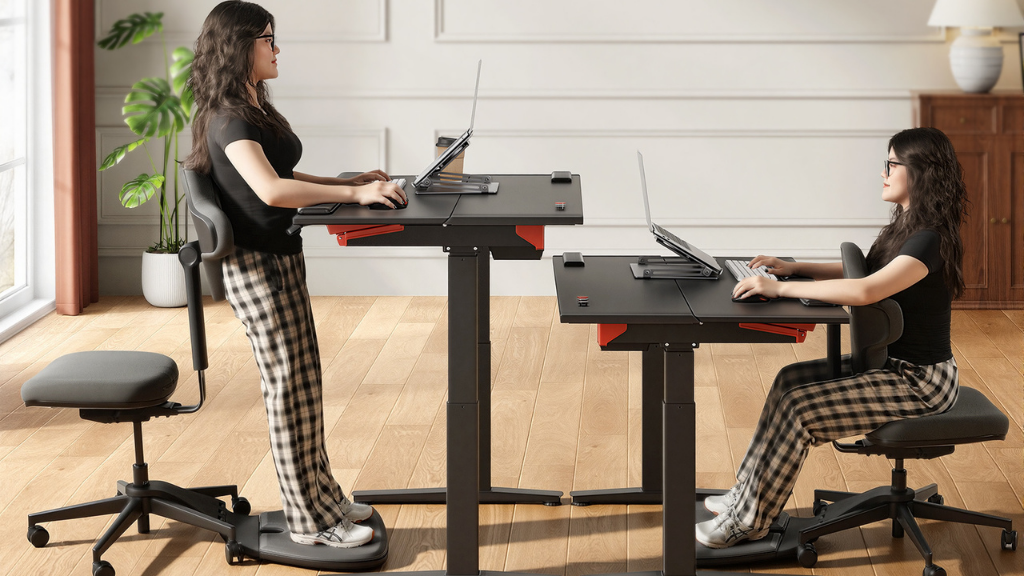
If you are setting up a sit-stand desk and wondering whether to pair it with a stool or a chair, the distinction matters more than it might seem. Here is a clear breakdown to help you decide.
What Is a Standing Desk Stool?
A standing desk stool is a height-adjustable seat without a backrest, designed to let you perch at or near standing desk height. Most stools feature a simple round or contoured seat on an adjustable post, sometimes with a slight forward tilt to encourage an open hip angle. The design is intentionally minimal: no lumbar support, no armrests, and a relatively small footprint.
Typical Use Cases
Stools work well for people who stand for most of the day and want occasional offloading of leg and foot pressure without fully sitting down. They are also popular in creative or active environments where the user moves around frequently and does not stay at the desk for long uninterrupted stretches.

What Is a Standing Desk Chair?
A standing desk chair is a fully adjustable seat with back support, designed to function across the range of postures that a sit-stand desk involves. Unlike a standard office chair, it extends to a higher seat height to accommodate perching and leaning positions, and the backrest adjusts to support the spine at angles relevant to near-standing use. It is essentially a chair that follows you through the full sit-stand workday rather than covering only one part of it.
Typical Use Cases
Standing desk chairs suit people who spend significant time at their desk and regularly switch between sitting, perching, and leaning throughout the day. They are particularly well suited to longer work sessions where postural support and fatigue management matter.

Key Differences Side by Side
Back Support
This is the most fundamental difference. A stool offers none. A standing desk chair provides an adjustable backrest that supports the lumbar spine whether you are sitting upright, perching, or leaning at standing height. For shorter sessions or users who are mostly on their feet, the absence of back support on a stool is manageable. For longer workdays, it becomes a meaningful limitation.
Height Range and Adjustability
Stools typically cover a narrower height range focused around standing desk height. Standing desk chairs offer a wider range, from standard seated height up to perching height, so they remain useful regardless of where your desk is set at any given moment. Finding the right seat height for your specific desk setup is worth doing before you buy. The Newtral ergonomic chair height calculator is a useful tool for working out your target range.
Posture Variety
A stool supports one posture: perching. A standing desk chair supports several, typically including upright sitting, reclined sitting, perching, and leaning with back or hip support. For users who shift positions frequently, this range reduces the cumulative strain that comes from holding any single posture too long.
Stability and Footprint
Stools are compact and lightweight, which makes them easy to move out of the way when not in use. Standing desk chairs have a larger footprint and are heavier, but they offer more stability when your weight is applied off-center during perching or leaning. For smaller workspaces, the stool's footprint advantage is real. For users who rely on the chair for active support throughout the day, the added stability of a chair base is worth the extra space.
|
Standing Desk Stool |
Standing Desk Chair |
|
|
Back support |
No |
Yes |
|
Height range |
Perching only |
Sitting to perching |
|
Posture variety |
Single posture |
Multiple postures |
|
Footprint |
Compact |
Larger |
|
Best for |
Short sessions, active users |
Long sessions, frequent switchers |

What Each Does Well
Where a Stool Has the Advantage
A stool is a practical choice when simplicity is the priority. It is easy to tuck under the desk, takes up minimal space, and requires no adjustment between uses. For users who prefer to stand most of the day and only need brief support, a stool delivers that without adding bulk to the workspace. It also tends to be more affordable, which makes it a straightforward starting point for people new to sit-stand setups.
Where a Chair Has the Advantage
A standing desk chair covers the full workday in a way a stool cannot. Beyond seated support, the backrest plays a less obvious but important role during standing intervals: leaning against back support while standing encourages core muscle engagement without loading the hips and knees the way unsupported standing does. Iris Sokol, a certified ergonomist with over 40 years of experience, notes that standing with back support allows you to remain partially weight-bearing while relieving the joint pressure that builds during unsupported standing.
The Newtral Standing Mate is built around exactly this range of use, with an adjustable backrest, extended height range, built-in standing mat, and support for multiple postures including a reverse open-hip position that gently stretches the back and provides a useful postural reset without leaving the desk.
Which One Suits Your Work Style?
Light or Short Standing Sessions
If you stand for relatively short periods and spend most of your time seated at a conventional desk height, a stool is a practical and space-efficient option. The lack of back support is less of a concern when the session length is short and you are not relying on it for sustained posture management.
Frequent Sit-Stand Switching
If you actively change positions throughout the day, a standing desk chair is the better fit. The ability to sit fully, perch, and lean with back support means the chair stays useful regardless of where your desk is set. A stool only becomes useful once the desk is raised, leaving you without meaningful support during seated work.
Long Hours at a Sit-Stand Desk
For extended workdays at a sit-stand setup, a standing desk chair is the clear choice. The backrest does more than support sitting: during standing intervals it takes load off the lower body, helps activate core muscles, and reduces the joint pressure that accumulates over hours on your feet. A stool used for the same duration places considerably more demand on the user's own musculature to maintain posture throughout the day.
Smart Standing Desk Setup Option
The chair or stool you choose is only part of the equation. A height-adjustable desk that moves smoothly and reliably between sitting and standing height makes the difference between a setup you actually use and one that stays in one position. The Newtral Smart Standing Desk pairs well with either seating option and is designed to support the kind of consistent position-switching that makes a sit-stand setup genuinely beneficial.

Conclusion
A standing desk stool and a standing desk chair serve different needs. A stool is simple, compact, and suited to shorter or more active use. A standing desk chair supports a full workday of varied postures with back support throughout. The right choice depends on how long you work and how often you actually switch positions.
FAQs
Can a standing desk stool replace an office chair?
For most desk workers, no. A stool covers the perching position but does not support seated work at standard desk height or provide lumbar support for longer sessions. It works best as a complement to a sit-stand setup rather than a full replacement for a seated chair.
Is a saddle seat the same as a standing desk stool?
Not exactly. A saddle seat has a distinctively shaped seat designed to tilt the pelvis forward and encourage an open hip angle, often used in medical or creative settings. A standing desk stool is a broader category that includes saddle-style seats but also covers flat or contoured seats without the saddle geometry.
Do I need back support at a standing desk?
It depends on how long you spend in any one position. For brief standing intervals, back support is less critical. For longer sessions, back support reduces the muscular load on the lower back and helps maintain posture without active effort. It also encourages core engagement during standing, which has its own benefit for back health over time.
Can I use both a stool and a chair at the same desk?
Yes, and some users do. A stool can serve as a quick perch for short transitions while a chair handles seated and longer standing sessions. In practice though, a purpose-built standing desk chair covers both scenarios on its own, which is the more space-efficient solution for most setups.


Leave a comment
All comments are moderated before being published.
This site is protected by hCaptcha and the hCaptcha Privacy Policy and Terms of Service apply.