
Table of Contents
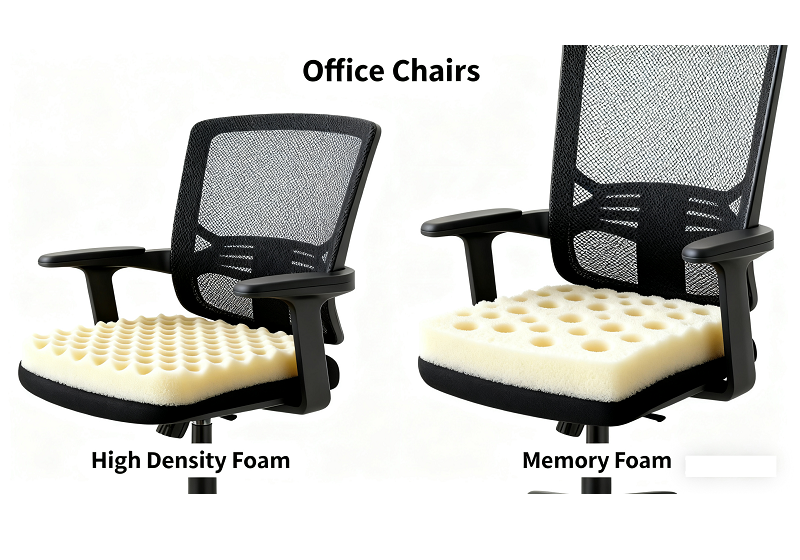
When choosing an chair, the type of foam directly affects comfort, support, and lifespan. High-density foam and memory foam are two of the most popular choices, each with its own strengths. This article will detail their characteristics and key differentiating factors to help you choose the most suitable chair.
What They Are and How They Differ in Chairs
Understanding the core traits of each foam type is essential to evaluating their performance in chairs.

High Density Foam
A polyurethane foam defined by its density, high density foam is a firm, durable choice focused on structural support-a staple in long-use ergonomic seating.
Memory Foam
Also called viscoelastic foam, memory foam is a specialized polyurethane designed for body-conforming comfort. Developed by NASA for astronaut cushioning, it’s now common in ergonomic chairs.
Differences Between High Density Foam and Memory Foam Chairs
The two foams follow distinct design logics: support-first (high density) vs. comfort-first (memory foam). Below is how they compare across critical performance areas.

Lumbar and Postural Support
High density foam delivers a stable foundation for consistent spinal alignment, ideal for 8+ hour workdays. Its firmness keeps the backrest and seat structured, maintaining the spine’s natural curve and preventing slouching.
Memory foam offers adaptive contouring to relieve pressure points-(tailbone, hips, lower back), great for users with pain. However, it carries a “sinking risk”: prolonged static seating can reduce support, leading to spinal misalignment.
Durability and Longevity
High density foam excels here, with a 5-10 year lifespan-and minimal sagging. Tightly packed cells resist breakdown, even with daily heavy use.
Memory foam lasts 3-7 years, with low-quality variants (<3 pcf) sagging faster. High-quality options (4-5 pcf) approach 7 years with care (e.g., rotating cushions), but heat exposure accelerates wear.
Comfort Over Time
High density foam provides immediate, steady firmness predictable comfort that avoids bottoming out, perfect for long work sessions requiring alertness.
Memory foam offers gradual, personalized contouring-(softens with body heat), ideal for relaxation. A tradeoff: it retains heat, which can cause discomfort in warm environments.
Practicality
Both carry minor off-gassing risks, mitigated by certifications like CertiPUR-US-(free of harmful chemicals). Maintenance is simple (vacuuming, spot cleaning), but memory foam needs breathable covers to prevent moisture buildup from heat retention.
Temperature sensitivity differs: high density foam is stable-(no softening in heat), while memory foam softens in warm conditions-a drawback for unconditioned spaces or outdoor use.
User-Centric Factors: Cost, Body Type and Usage
Your needs determine the better foam. Here’s how to align them.

Price and Value
High density foam chairs have lower upfront costs-(\(150-\)300 for basic ergonomic models) due to simpler production. Their 5-10 year lifespan makes them cost-effective long-term.
Memory foam chairs cost more (\(250-\)500) for specialized comfort. The premium is justified if you need pressure relief (e.g., chronic pain), but they offer less value for budget or shared spaces.
Body Type Compatibility
- Heavier users (250+ lbs/113+ kg): High density foam’s weight-bearing resilience prevents sagging and uneven support.
- Users with joint pain/small frames (<150 lbs/68 kg): Memory foam’s pressure dispersion eases discomfort and provides softer, tailored support.
Usage Scenarios
- All-day workstations (task/executive chairs): High density foam’s steady support suits 8+ hour use.
- Relaxation (recline chairs): Memory foam’s contouring enhances comfort for reading or lounging.
- Meeting chairs: High density foam’s durability and low maintenance work for frequent shared use.
Ideal for High Density Foam
Choose it if you:
- Use the chair 8+ hours daily (e.g., office work).
- Prioritize posture correction and durability.
- Need a budget-friendly or shared-space chair (meeting rooms, co-working).
Ideal for Memory Foam
Choose it if you:
- Have lower back/hip pain or joint issues.
- Use the chair for 4-6 hour sessions (e.g., reading, light work).
- Want secondary cushioning (e.g., lumbar pillows paired with a high density base).
Hybrid Solutions: The Best of Both
Many premium chairs combine a high density foam base-(for support) with a memory foam top layer-(for comfort). This balances durability and pressure relief-ideal for users who want both steady alignment and personalized cushioning.
Final Verdict
There’s no “one-size-fits-all” winner:
- High density foamis better for all-day support, durability, and budget.
- Memory foamexcels at pain relief and relaxation.
For most users, a hybrid design offers the optimal balance. Always check density ratings and CertiPUR-US certification to ensure quality, and align your choice with your daily usage and body needs.
Blog18
blog18
Related reading:



Leave a comment
All comments are moderated before being published.
This site is protected by hCaptcha and the hCaptcha Privacy Policy and Terms of Service apply.