
You sit to work. That is normal. Staying still for too long is not. “Office Chair Butt” means your glutes become weaker, flatter, and less responsive after prolonged static sitting. The fix is simple: move often, activate your glutes, and load them progressively. Feed your muscles with enough protein, manage stress, and get solid sleep. This guide gives you clear steps, short sentences, and practical tables so you know exactly what to do today.
What Is “Office Chair Butt”?
You are not broken; you are deconditioned from stillness. Long, static sitting reduces blood flow and nerve drive, so your glutes “switch off” and other muscles compensate. That is why your hips feel tight and your low back works harder. The good news: muscles are highly adaptable. When you activate and train them again, tone, strength, and shape return quickly.

1. Is Office Chair Butt Real?
Yes. It is a mild form of gluteal atrophy. You notice less firmness and slower hip power when you stand, climb stairs, or walk uphill. With daily activation and progressive loading, you feel a difference within days and see changes within weeks. Buy ergonomic office chairs to speed up your recovery.
2. Dead Butt Syndrome (Gluteal Amnesia)
After hours of sitting, your glutes “forget” to turn on. Hip flexors tighten, your pelvis tilts forward, and your low back takes over. You feel stiffness when you stand and pinching at the front of the hip. Reactivation drills restore the pattern fast.
3. Why Sitting Isn’t Always the Enemy
Sitting is not the problem. Stillness is. Micro-movements, posture changes, and brief breaks keep circulation and joint nutrition flowing. One minute of movement each hour matters more than you think.
What Does Chair Butt Look Like?
You may see flattening or asymmetry and feel soreness near the sit bones. Pants fit looser at the seat, and your stride feels less springy. These changes are reversible. Your plan is simple: detect early, activate daily, and load progressively so you rebuild tone, shape, and function.

How Long Does It Take to Develop — and Can You Reverse It?
You can notice early signs after two to three weeks of heavy sitting with low activity. With consistent practice, most people reverse them in four to six weeks. Progress depends on sleep, stress, steps per day, and how well you follow a simple plan: activate first, strengthen next, and then maintain with habits.
How Fast It Develops
Low steps and long static sessions speed decline. Frequent micro-breaks and small posture changes slow it down.
Stages of Muscle Weakness
You usually lose activation first, then endurance, and finally strength and shape. Rebuild in the opposite order: wake up the muscle, add volume, then add load.
Reversal Timeline (4–6 Weeks)
In weeks one to two, do activation drills daily. In weeks three to four, add strength training two or three days per week. In weeks five to six, increase load and range while keeping your daily movement targets.
The Formula: Activate → Strengthen → Maintain
Wake the muscle with low-effort drills. Strengthen it with progressive resistance. Maintain with daily triggers and short, repeatable habits.
How Office Chair Butt Affects Posture and Performance
Your glutes stabilize your pelvis and protect your spine and hips. When they are weak, you slide into anterior pelvic tilt, compress the low back, and shorten your steps. Fixing the base improves everything above and below: less back strain, better hip extension, stronger gait, and more energy through the day.
Pelvic Tilt and Spinal Alignment
Weak glutes allow the pelvis to tip forward. That increases lumbar compression and neck strain. Restoring glute strength makes neutral alignment easier and more natural.
Weak Glutes = Back and Hip Pain
When the hips lack support, the lumbar spine compensates. You feel dull aches after long tasks. Glute activation reduces the load on the back and helps your core work as designed.
Reduced Balance, Walking, and Energy
Your glutes drive hip extension. When they lag, you lose push-off power, stride length, and stability. Rebuilding glute endurance and strength restores efficient movement.
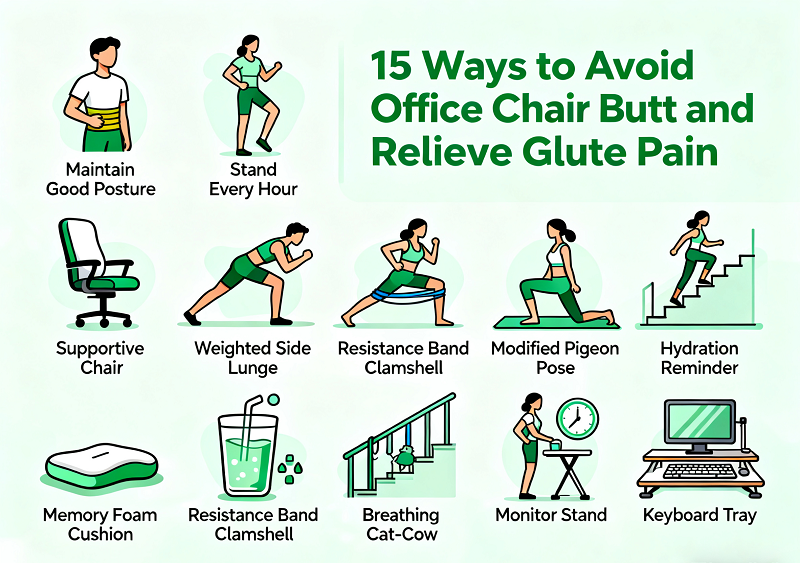
15 Ways to Avoid Office Chair Butt
You do not need a perfect chair or a complex plan. You need simple, consistent actions. Use these tactics to add movement and keep activation high all day.
Stand every 30–60 minutes. Set a timer. One minute is enough to reset circulation.
Alternate sit and stand. If you have a sit-stand desk, switch every hour to re-engage your hips.
Do seated glute squeezes. Ten seconds on, ten seconds off, for one to two minutes.
Use mini breaks for drills. Bridges, clamshells, and side leg lifts keep activation alive.
Stretch hip flexors and hamstrings. Loosen the brakes so the glutes can fire.
Choose an ergonomic or active-sitting chair. Allow gentle rocking and pelvic tilt.
Use a pressure-relief cushion. Contoured or U-cut cushions reduce sit-bone stress.
Rotate seating modes. Ergonomic chair, kneeling chair, or a brief stability-ball block.
Hydrate and move. Link water breaks to quick stands and posture resets.
Walk during calls. Pace the room or march in place to keep hips warm.
Use smart prompts. Watch reminders or desktop nudges build consistency.
Strength train outside work. Two to three short sessions per week beat long gaps.
Dial in posture. Hips back in the chair, ribs down, feet flat, knees near 90°.
Try posture trackers or smart cushions. Alerts help you avoid “time drift.”
Take active micro-breaks. Stairs, calf raises, or quick hip openers refresh your system.
Best Exercises to Fix Office Chair Butt
Start with activation, then progress to strength. Keep the motion clean and pain-free. Move through a comfortable range, then expand it gradually as tissues warm up and coordination improves.
Activation
Glute bridges and clamshells are your daily warm-ups. They turn on the glute max and glute med, reduce hip pinching, and set your pelvis in a better position before heavier work.
Strength
Squats, lunges, and hip thrusts build real shape and power. Use slow eccentrics, a pause in the bottom, and a firm lockout to maximize tension where you need it most.
Isolation & Stability
Donkey kicks, side-lying leg raises, and standing hip extensions target lagging fibers and improve balance. Add light ankle weights or a small band as you progress.
Table 1 – Exercise menu (start here)
|
Exercise |
Primary muscles |
Key cues |
Beginner sets × reps |
|
Glute bridge |
Glute max |
Heels down, ribs down, squeeze at top 1–2 s |
3 × 10–12 |
|
Clamshell |
Glute med/min |
Hips stacked, small range, no trunk roll |
3 × 12–15 |
|
Bodyweight squat |
Quads, glutes |
Knees track toes, full foot pressure |
3 × 8–10 |
|
Reverse lunge |
Glutes, hamstrings |
Long step back, tall torso |
3 × 8/side |
|
Hip thrust |
Glute max |
Chin tucked, mid-back on bench, hard lockout |
3 × 8–12 |
|
Donkey kick |
Glute max |
Neutral spine, heel to ceiling |
2–3 × 10/side |
|
Side-lying leg raise |
Glute med |
Toes slightly down, controlled lower |
2–3 × 12/side |
|
Standing hip extension |
Glute max |
Brace core, small arc, squeeze at end |
2–3 × 10/side |
Nutrition Tips to Support Glute Recovery
You build the tissue you feed. Aim for 1.2–1.6 g of protein per kilogram of body weight per day to support repair and growth. Add omega-3 fats to calm inflammation and magnesium for muscle relaxation and sleep quality. Hydrate so tissues stay elastic and responsive. Distribute protein across meals to keep muscle protein synthesis active.
Table 2 – Simple nutrition checklist
|
Nutrient |
Best foods |
Daily target |
Function |
|
Protein |
Eggs, Greek yogurt, poultry, tofu |
1.2–1.6 g/kg BW |
Repair, growth, satiety |
|
Omega-3 |
Salmon, sardines, flax, chia |
2–4 servings/week or 1–2 g/day EPA+DHA |
Inflammation control |
|
Magnesium |
Pumpkin seeds, almonds, leafy greens |
300–400 mg |
Muscle relaxation, sleep |
|
Hydration |
Water, herbal tea |
Clear urine most of day |
Tissue elasticity, recovery |
Ergonomic Workspace Setup to Prevent Office Chair Butt
Good ergonomics make good habits easier. Set your desk, monitor, seat, and foot support so neutral posture feels effortless. Then sprinkle movement on top of that neutral base.
Table 3 – Perfect sitting setup
|
Element |
Ideal position |
Why it helps |
|
Desk height |
Elbows ~90° when typing |
Keeps shoulders relaxed |
|
Monitor |
Top at or slightly below eye level |
Reduces neck strain |
|
Seat height |
Hips slightly above knees |
Encourages neutral pelvis |
|
Lumbar support |
Small cushion at low back |
Maintains natural curve |
|
Foot support |
Feet flat or on footrest |
Stabilizes pelvis and core |
|
Armrests |
Just under elbow height |
Offloads traps and neck |
How the NT002 Ergonomic Chair Helps Prevent Office Chair Butt
You still need movement, but chair design can help. Newtral NT002 encourages micro-movement with a responsive seat pan and supportive backrest. Pressure is spread across a larger area, so your sit bones feel less stress and your glutes stay more comfortable for longer blocks of work. Easy adjustability lets you switch angles quickly, which is exactly what your hips need.

Table 4 – NT002 vs a typical office chair (at a glance)
|
Feature |
NT002 |
Typical chair |
Benefit to you |
|
Dynamic seat tilt |
Yes, smooth micro-rock |
Minimal or fixed |
Encourages micro-movement |
|
Pressure distribution |
Contoured, multi-zone |
Flat cushion |
Less sit-bone stress |
|
Backrest adjustability |
Height + tilt with lock |
Limited tilt |
Faster posture changes |
|
Edge design |
Waterfall front edge |
Flat or sharp edge |
Less hamstring pressure |
When to See a Physical Therapist
Get help if you feel persistent hip or tailbone pain, numbness, sharp pinching, or visible asymmetry that does not improve after two to three weeks of diligent work. A physical therapist can assess posture, mobility, and muscle firing patterns, then build you a tailored activation and loading plan. Early guidance prevents chronic compensation.
Common Mistakes and Misconceptions
“Softer cushion equals better” is not always true; you want support and movement, not a sinkhole. Buying a new chair without changing habits rarely fixes the problem. Do not jump into heavy lifts with cold hips after long sitting; activate first. Do not ignore the core and hips that support your pelvis. Focus on function first; appearance follows function. Visit newtralchair.com to choose a comfortable chair.
FAQs About Office Chair Butt
Q1: How do you know if you have it?
You feel stiffness after sitting, less firmness, and weaker hip drive when standing or walking uphill.
Q2: How long before sitting affects your glutes?
You may notice changes in two to three weeks of static routines.
Q3: Can a cushion or chair fix it alone?
No. Tools help, but movement and training do the real work.
Q4: What exercises rebuild glutes the fastest?
Hip thrusts, bridges, and lunges with good form and progressive loading.
Q5: Is it permanent?
No. Muscles are highly adaptable. Most people improve in four to six weeks with consistency.
Q6: How often should you stand?
Every 30–60 minutes, even for one minute, to reset circulation.
Q7: What daily routine prevents recurrence?
Activate in the morning, move each hour, strength train two to three days per week, and maintain protein and sleep.

Leave a comment
All comments are moderated before being published.
This site is protected by hCaptcha and the hCaptcha Privacy Policy and Terms of Service apply.