
Table of Contents
Pairing the right chair with a standing desk makes a bigger difference than most people expect. This guide walks through what to look for, how sit-stand seating actually works, and how to match a chair to the way you actually work.
Why Standing Desks and Standing Desk Chairs Go Together
Why Standing Desk Setups Are Becoming Common
Prolonged sitting has been linked to lower back pain, poor circulation, and reduced energy levels. The World Health Organization has highlighted sedentary behavior as a significant contributor to musculoskeletal problems among office workers.
That said, the real issue may be less about sitting itself and more about staying in any one position for too long. Iris Sokol, a certified ergonomist with over 40 years of experience in health, wellness, and ergonomics, puts it this way: the problem is not sitting, it is the lack of movement. Sit-stand setups address this directly by making it easier to shift positions throughout the day rather than staying locked into one posture for hours.
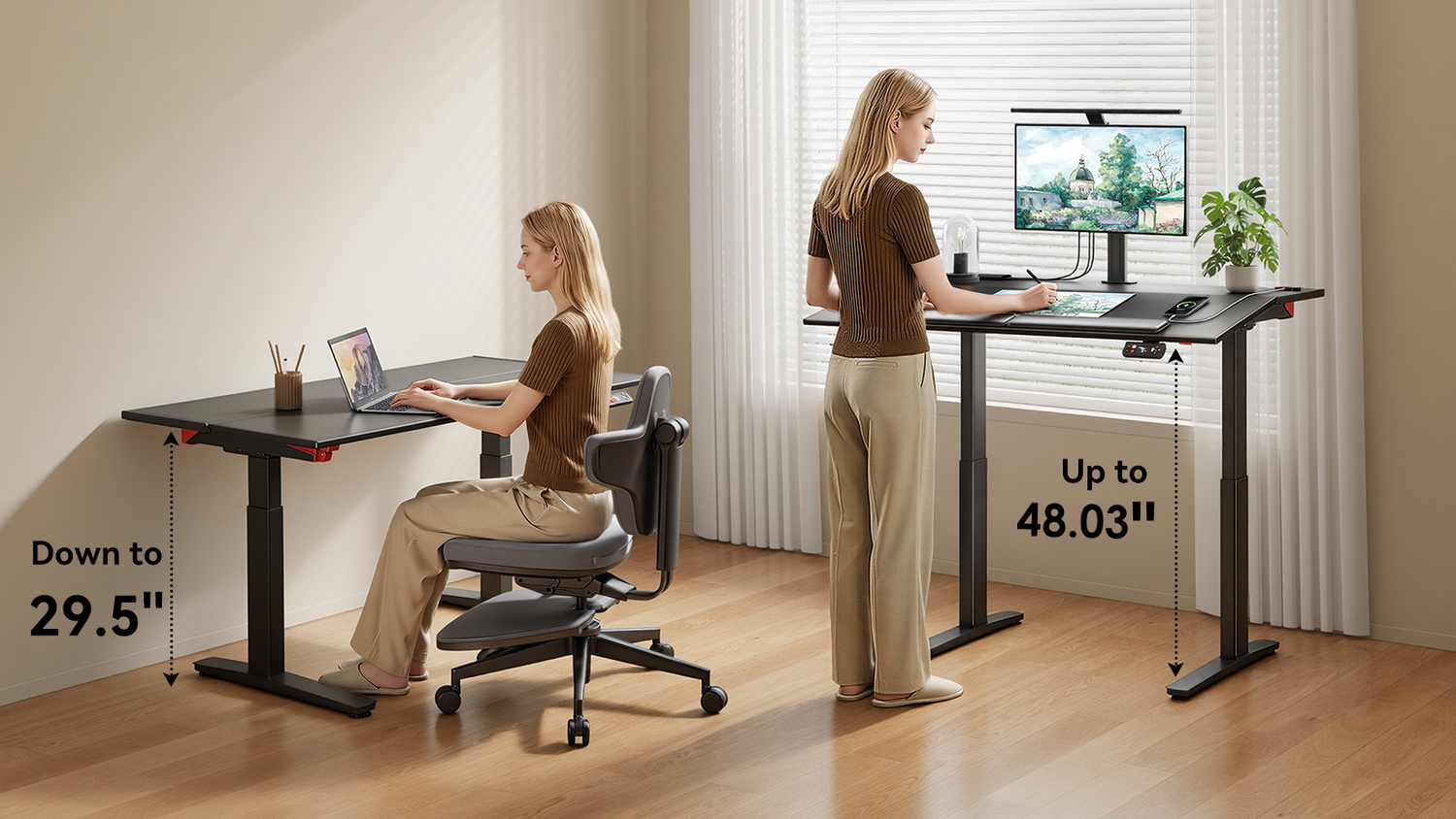
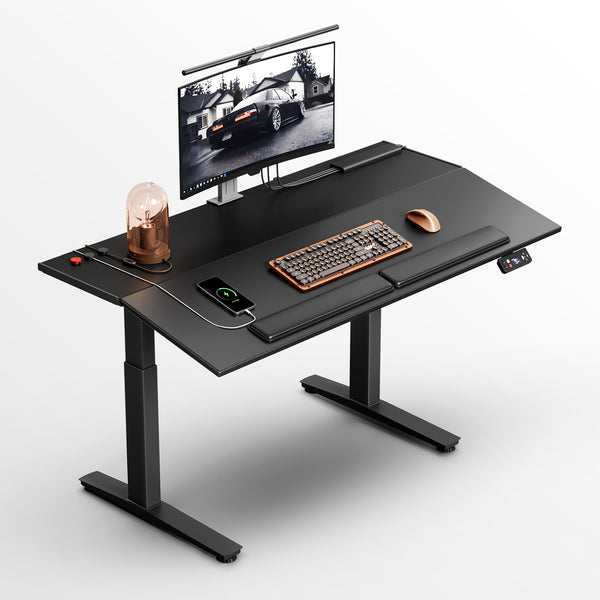
A height-adjustable desk is the starting point for any sit-stand setup. The Newtral Smart Standing Desk is built with this workflow in mind, offering a stable and adjustable foundation that pairs well with a purpose-built standing desk chair.

Why You Still Need a Standing Desk Chair
Standing all day is not the answer either. As Sokol points out, standing is simply a different static posture, and one that places its own stress on the hips, knees, feet, and circulation when held without support. In her ergonomic evaluations, she regularly observes people standing with locked knees, weight shifted into one hip, and back arched, all patterns that build strain over time. Standing without engagement from the core muscles, she notes, is particularly problematic for back health.
A regular office chair does not help here: it is built for a fixed desk height and a single seated posture. Once your desk starts moving, the chair cannot follow. A chair designed for standing desks fills this gap by supporting sitting, perching, and leaning across the full range of a sit-stand workday.
How Standing Desk Seating Actually Works
Sitting, Perching, and Standing Transitions
At sitting height, you want full seat and back support. As your desk rises, your posture shifts: you may perch toward the front of the seat with your hips elevated, or lean back lightly while remaining mostly upright.
These positions have different support requirements and shift fluidly throughout the day. A practical guideline from ergonomics practice: for every 50 minutes of static posture, around 5 minutes of movement helps break up the muscular tension that builds in your muscles and joints.
Why Traditional Chairs Fall Short
A conventional office chair is optimized for one posture: fully seated at a fixed height. When you try to perch or lean, the seat height range is too low and the backrest angle is wrong for a near-standing position. It simply is not built for the range of movement a sit-stand desk involves.
What Sit-Stand Compatibility Means
A sit-stand compatible chair functions usefully across both the height range and posture range of a sit-stand desk: a seat that rises to perching level, a backrest that supports leaning rather than just sitting, and a stable base when your weight shifts. Compatibility is not just about specs on paper. It is about whether the chair holds up across the full variety of how you actually use your desk.

Standing Desk Chair Features to Look For
Height Range: Does It Match Your Desk?
This is the most practical specification to check first. To find your target range, measure your desk at both sitting and standing height, then determine where you will want the seat to sit relative to each position. As a general reference:
- Standard office chairs adjust between roughly 16 and 21 inches from floor to seat
- Chairs designed for standing desks typically extend into the 24 to 32 inch range for perching positions
If the chair's height range does not cover your working positions, no other feature compensates for that.
Backrest Adjustability
At different desk heights and postures, the backrest needs to land in a different place. A fixed backrest angle that works well when seated may offer nothing useful at standing height. Look for a backrest that adjusts in both angle and height so it provides genuine support whether you are:
- Sitting upright at desk height
- Leaning back slightly during a break
- Perching with your weight shifted forward
Seat Depth and Tilt
Seat depth affects how much thigh support you have when sitting and whether you can shift your weight forward naturally when perching. A useful rule of thumb from ergonomics practice: there should be roughly a fist's width of clearance between the back of your knee and the front edge of the seat. Key things to check:
- A seat that is too deep pushes you into the backrest even when you want to sit toward the front edge
- A forward tilt option, even a modest one, helps maintain a neutral pelvis during perching positions
Base Stability and Casters
A chair that tips or rolls when you are perching or leaning is both a comfort and a safety concern. Look for:
- A base that is proportionally wide relative to the seat height at its upper range
- Casters that roll smoothly without letting the chair drift when body weight is applied at an angle
- Some models use a wider star base or weighted base specifically for stability at higher seat positions
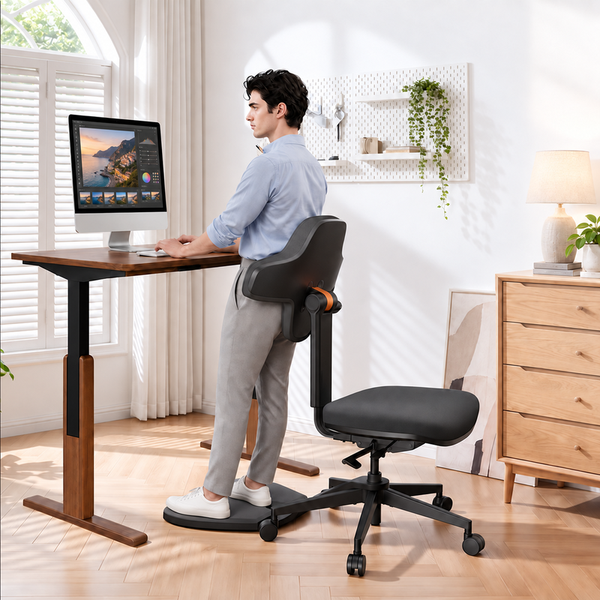
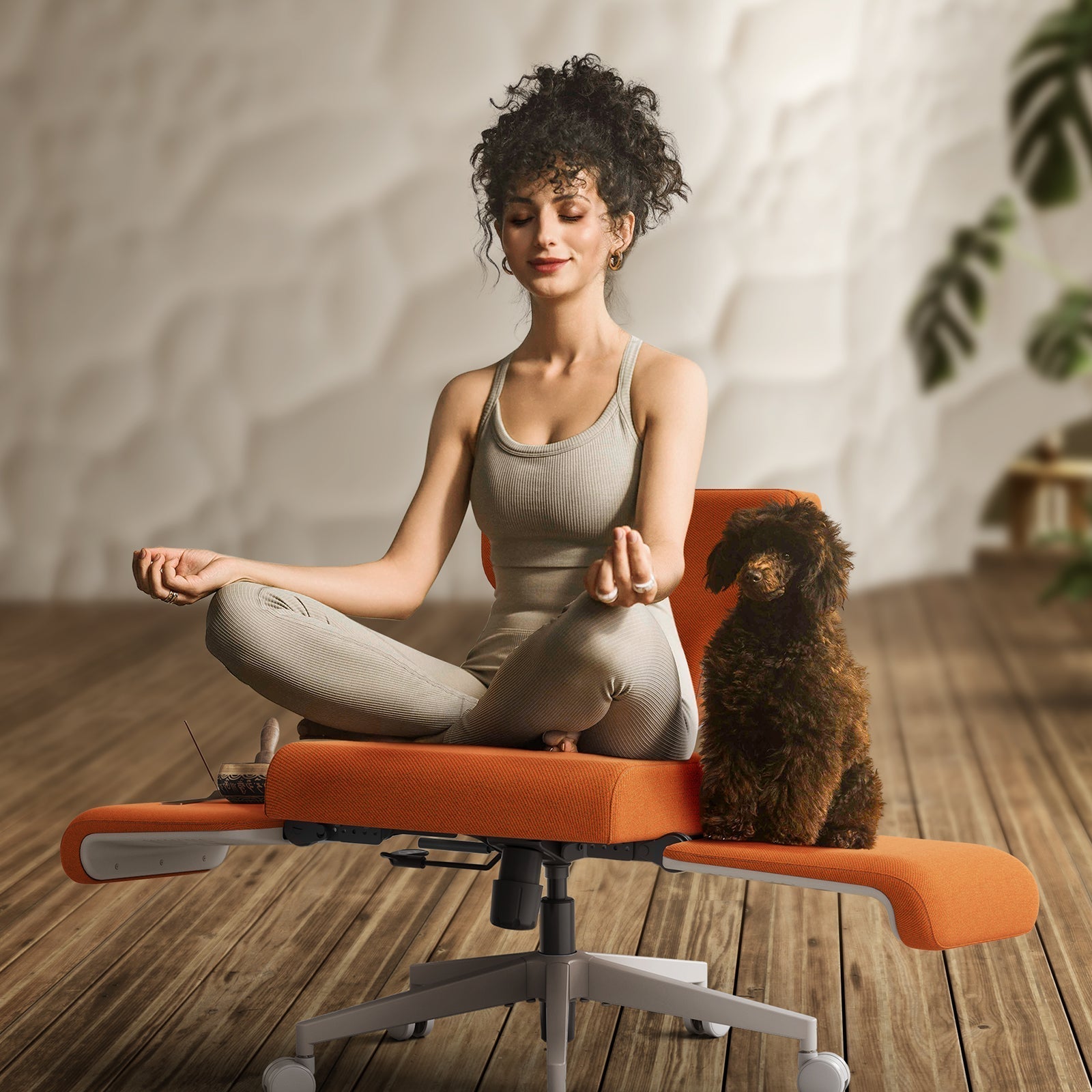
The Newtral Standing Mate is designed around sit-stand desk use, with an adjustable backrest, extended height range, and a built-in standing mat for the moments you step away from the seat. This is the first chair Iris Sokol has seen that genuinely solves the sitting-to-standing gap. Prior to this, the only options were a standard chair or a saddle-style leaning seat with no lumbar support, with nothing bridging the two.
Standing Desk Chair vs. Regular Office Chair
What Sit-Stand Chairs Are Designed to Solve
Chairs built for standing desks address the limitations of standard seating directly. The height range extends upward to support perching. The backrest adjusts to positions that make sense when your hips are elevated and your weight distribution is different from a standard seated posture. Some models include features like a forward-tilt seat, chest support, or an integrated anti-fatigue mat to make transitions smoother and reduce fatigue during longer standing intervals.
|
Feature |
Regular Office Chair |
Standing Desk Chair |
|
Seat height range |
~16–21 inches |
~15–32 inches (varies by model) |
|
Perching support |
No |
Yes |
|
Backrest for near-standing posture |
No |
Yes |
|
Designed for sit-stand transitions |
No |
Yes |
Blog12
Blog18
When a Regular Chair Is Still Sufficient
If you spend the majority of your workday seated and only raise your desk occasionally, a well-specified ergonomic office chair may still serve you adequately. The case for a purpose-built standing desk chair gets stronger the more frequently you actually change positions during the day. If your sit-stand desk stays at one height most of the time, a standard ergonomic chair is probably sufficient.

Choosing Based on Work Style
How often you switch positions throughout the day should shape which chair features you prioritize.
Long Sitting, Focused Users
If your work involves extended stretches of deep concentration, seated comfort is the primary concern. Prioritize lumbar adjustability, seat cushion quality, and a backrest that can lock into your preferred angle. A wider height range matters less if you rarely perch or transition to standing mode.
Frequent Sit-Stand Switchers
This is where a purpose-built standing desk chair makes the clearest difference. If you are changing positions several times per hour, you need a chair that accommodates the full range of your movement rather than one you have to work around. Focus on seat height range, perching comfort, and a base that stays stable when your weight shifts off-center. A forward-tilt seat option and an adjustable backrest are particularly valuable here.
Minimal Sitting, Active Standing Users
Some people use their desk in standing mode for the majority of the day and sit only briefly. In this case, the chair primarily serves as a support for leaning and a way to offload leg and foot fatigue during long standing sessions. Look for chest and hip support options, a compact footprint that stays out of the way when not in use, and an integrated anti-fatigue mat if possible.
Conclusion
Choosing a chair for a standing desk comes down to matching the chair's capabilities to how you actually work. Start with the height range, then look at backrest adjustability, seat depth, and base stability. If you switch positions frequently throughout the day, a chair purpose-built for sit-stand use will serve you significantly better than a standard office chair. You can also review the Newtral after-sales policy for warranty and support details before making a decision.
Related reading:




Laisser un commentaire
Tous les commentaires sont modérés avant d'être publiés.
Ce site est protégé par hCaptcha, et la Politique de confidentialité et les Conditions de service de hCaptcha s’appliquent.