
Table of Contents
Switching to a height-adjustable desk is a smart move for your posture and energy levels, but the chair you pair it with matters just as much as the desk itself. Two options come up frequently in ergonomics discussions: the saddle chair and the standing desk chair. They look different, feel different, and serve different purposes.
This guide breaks down both so you can decide which one fits yours work style, body, and budget.
What Is a Saddle Chair?
How It Works
A saddle chair is named for its shape, which closely resembles a horse saddle. The seat tilts forward at an angle, typically between 10 and 30 degrees, which encourages your pelvis to rotate forward and your spine to settle into a natural S-curve. Your thighs slope downward, your hips open up, and pressure around the hip joints decreases compared to sitting on a flat seat.
Because there is no seat back, your core and lower back muscles do more of the stabilizing work. This can strengthen those muscle groups over time, but your posture ultimately depends on how long they can hold up.
Common Designs
Saddle chairs come in three main variations:
- Backless saddle stools are the most traditional form. Lightweight and mobile, they encourage active core engagement and are widely used in dental clinics and medical settings where mobility and reach take priority.
- Saddle chairs with a backrest add lumbar or full back support for users who want relief during longer sessions without giving up the forward-tilted seat angle.
- Split-seat saddle chairs feature a two-piece seat divided down the middle, reducing inner thigh pressure and allowing each side to move independently. Many users find this more comfortable for extended sitting.

What Is a Standing Desk Chair?
How It Works
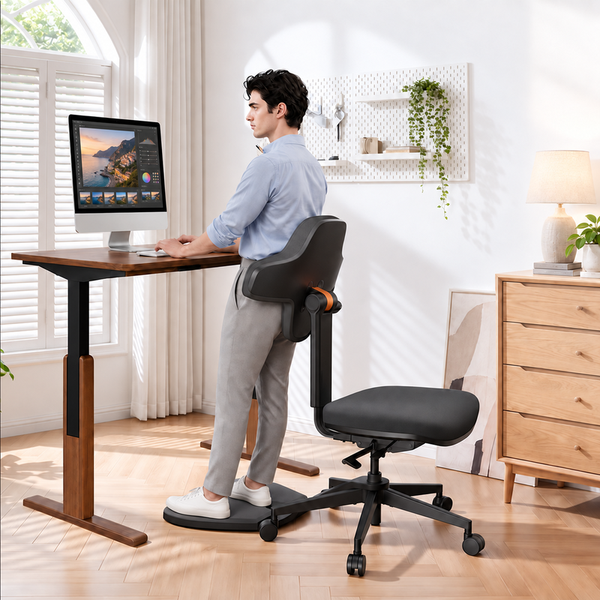
A standing desk chair, sometimes called a sit-stand stool or leaning chair, is built specifically to pair with height-adjustable desks. Unlike a standard office chair, it operates at elevated heights, typically ranging from 23 to 33 inches or higher depending on the model. You can lean against it while standing, perch at a semi-seated angle, or lower it to a more traditional seated position when your desk comes down.
The design keeps you mobile and engaged rather than locked into a single posture. Most models feature a dynamic base that allows slight movement or tilt, which activates your muscles and reduces the fatigue that builds up from staying in one position too long.
Who It's Designed For
Standing desk chairs are built for people who spend most of their workday at a height-adjustable workstation and want continuous support across multiple postures throughout the day.
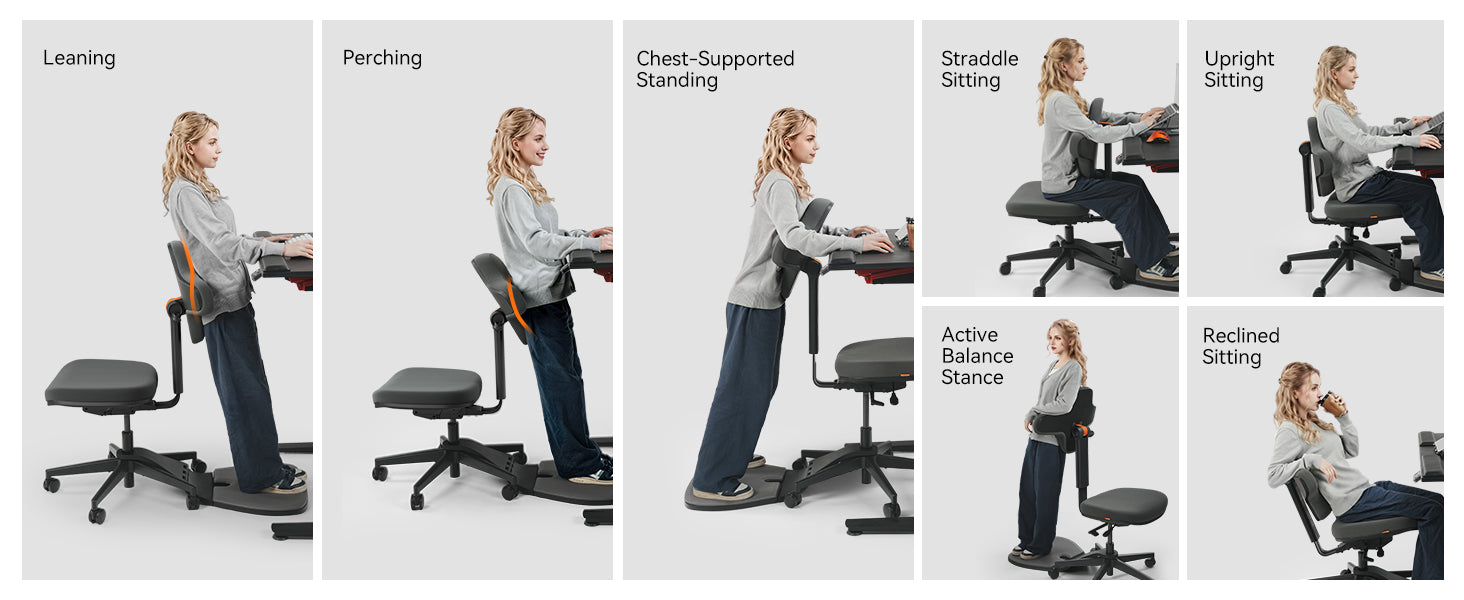
The ergonomic standing desk chair is a strong example of what a well-designed standing desk chair can offer. It supports eight different postures, includes a flip-adjustable backrest for on-demand lumbar support, and comes with an integrated standing mat, making it a complete solution for active sit-stand workstations.

Saddle Chair vs. Standing Desk Chair
Posture and Spinal Support
A saddle chair promotes spinal alignment through forward pelvic tilt. A 2017 study published in Work: A Journal of Prevention, Assessment and Rehabilitation found statistically significant improvements in thoracic kyphosis depth and trunk inclination angle when participants used a saddle chair compared to a standard office chair, with lumbar lordosis curves more closely matching a natural neutral position. This works well when your core stays engaged, but without a backrest, posture relies on muscular endurance and can drift once those muscles fatigue.
A standing desk chair supports a wider range of postures across the day. A flip-adjustable backrest, like the one on the Standing-Mate, lets you switch between active perching and supported sitting on demand, without compromising spinal alignment either way.
Blog12
Blog18
|
Saddle Chair |
Standing Desk Chair |
|
|
Spinal alignment |
Forward pelvic tilt promotes natural curve |
Flexible across multiple seated and leaning positions |
|
Back support |
Minimal or none (varies by model) |
Often includes adjustable backrest |
|
Core engagement |
High |
Moderate |
|
Best suited for |
Short to medium sessions |
Full workdays |
All-Day Comfort and Fatigue
Saddle chairs work well for shorter sessions or tasks where you move around frequently. For people sitting six or more hours at a stretch, the absence of back support and the unfamiliar seat angle can lead to fatigue, particularly in the early weeks of use.
Standing desk chairs handle full workdays more comfortably. The ability to shift between leaning, perching, and sitting means your body is not held in one position for hours. A chair that supports eight distinct postures, as the Standing-Mate does, gives you meaningful variety across a long workday, which is one reason ergonomists favor this type for extended desk work.
Standing Desk Compatibility
Saddle chairs are primarily designed for standard desk heights. Many models max out around 24 to 26 inches, which may not be sufficient when a sit-stand desk is raised to a standing or mid-height position.
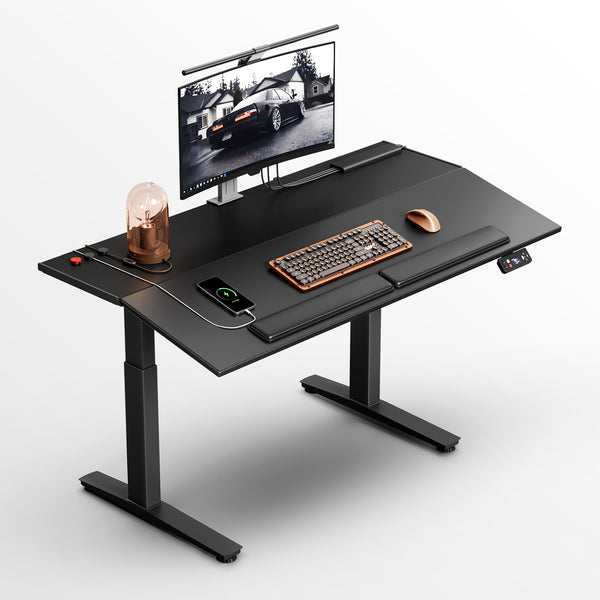
Standing desk chairs are built for elevated heights by design. A height-adjustable desk like the Newtral Smart Standing Desk moves through a full range of positions, and a standing desk chair is purpose-built to match it at every level. The Standing-Mate's integrated standing mat also adds cushioned underfoot support whether you're leaning or standing, eliminating the need for a separate mat.
Blog18

Learning Curve
Saddle chairs come with a noticeable adjustment period. Research evaluating saddle chair use in professional settings assessed posture outcomes after 10 to 12 weeks of regular use, reflecting how much time the body needs to meaningfully adapt. Most users experience muscle soreness in the hips and lower back during the first one to two weeks as stabilizing muscles activate and strengthen. Starting with 30 to 60 minutes per day and increasing use gradually is a widely recommended approach.
Standing desk chairs are more straightforward to adopt. If you're used to a standard office chair, the transition is gentler, though it's still worth experimenting with height and tilt settings before committing to a full workday in one.
Price
|
Entry-Level |
Mid-Range |
Premium |
|
|
Saddle Chair |
$80 to $150 |
$150 to $250 |
$250 to $400+ |
|
Standing Desk Chair |
$150 to $200 |
$200 to $350 |
$350 to $600+ |
Saddle chairs are generally more affordable at the entry level. Standing desk chairs start higher due to the engineering required for multi-height use and multi-posture support.
How to Choose?
Choose a Saddle Chair If...
A saddle chair is a strong fit if you work in short, focused bursts and naturally change positions throughout the day. It suits people who want a lightweight, minimalist seating option that encourages active posture without the bulk of a traditional ergonomic chair. It also performs well in clinical settings, creative studios, and workspaces where mobility matters more than extended seated comfort.
Keep in mind that saddle chairs work best for people with reasonable core strength. If you're managing an existing back condition or recovering from an injury, consult a healthcare provider before making the switch.
Blog12
Blog18
Choose a Standing Desk Chair If...
A standing desk chair is the more practical choice if you spend most of your workday at a desk and need consistent support through sitting, leaning, and standing without swapping chairs mid-day. It's especially well-suited for anyone who has already invested in a height-adjustable desk and wants to take full advantage of its range.
It's also the better option if you need back support throughout the day, prefer a gentler transition from a standard chair, or work long hours with few natural movement breaks.
Can You Use Both?
Some people use both at the same workstation. A saddle chair works well at a lowered desk position during focused tasks, while a standing desk chair handles longer sessions or semi-standing work. Rotating between the two adds postural variety if budget and space allow.

Conclusion
Saddle chairs and standing desk chairs both have a place in ergonomic workspaces, but they serve different users. A saddle chair is best for active, short-duration sitting. A standing desk chair is the stronger choice for all-day support across multiple postures at a sit-stand desk.
Regardless of which chair you choose, dialing in the correct height for your body is essential. The Ergonomic Chair and Desk Height Calculator can identify your optimal setup based on your height in just a few seconds.
FAQs
Is a saddle chair good for back pain?
It depends on the cause. A saddle chair's forward pelvic tilt can relieve pressure on the lumbar discs and help with certain types of lower back pain. However, because it requires active core engagement to maintain posture, it can worsen discomfort for people with weak back muscles or existing injuries. If you have chronic back pain, consult a physiotherapist or ergonomics specialist before switching.
Is a saddle chair good for sciatica?
A saddle chair can benefit some people with sciatica by reducing compression around the sciatic nerve through its open hip angle. However, the forward tilt that helps some users can aggravate others, particularly when nerve irritation is linked to piriformis tightness or lumbar instability. Responses vary considerably, so if your symptoms are ongoing, speak with a healthcare professional before committing to a saddle chair.
How to sit in a saddle chair?
Start by adjusting the seat height so your hips are slightly higher than your knees and your feet rest flat on the floor. Sit toward the middle or back of the saddle rather than on the tip. Let your pelvis tilt forward naturally without forcing it, and keep your shoulders relaxed with your screen at eye level. For the first week or two, limit sessions to 30 to 60 minutes and increase gradually as your body adjusts.
Do you need a back cushion with a saddle chair?
Not necessarily. Saddle chairs are intentionally designed without a backrest to promote active posture, and adding support behind you changes the mechanics the chair is built around. If the seat surface feels uncomfortable, a saddle-specific seat cushion can help with pressure distribution. If you regularly find yourself reaching for back support during use, a saddle chair with an integrated backrest or a different chair type may be a better long-term fit.





Hinterlasse einen Kommentar
Alle Kommentare werden vor der Veröffentlichung geprüft.
Diese Website ist durch hCaptcha geschützt und es gelten die allgemeinen Geschäftsbedingungen und Datenschutzbestimmungen von hCaptcha.